The Four Pillars of Consistent Profitability
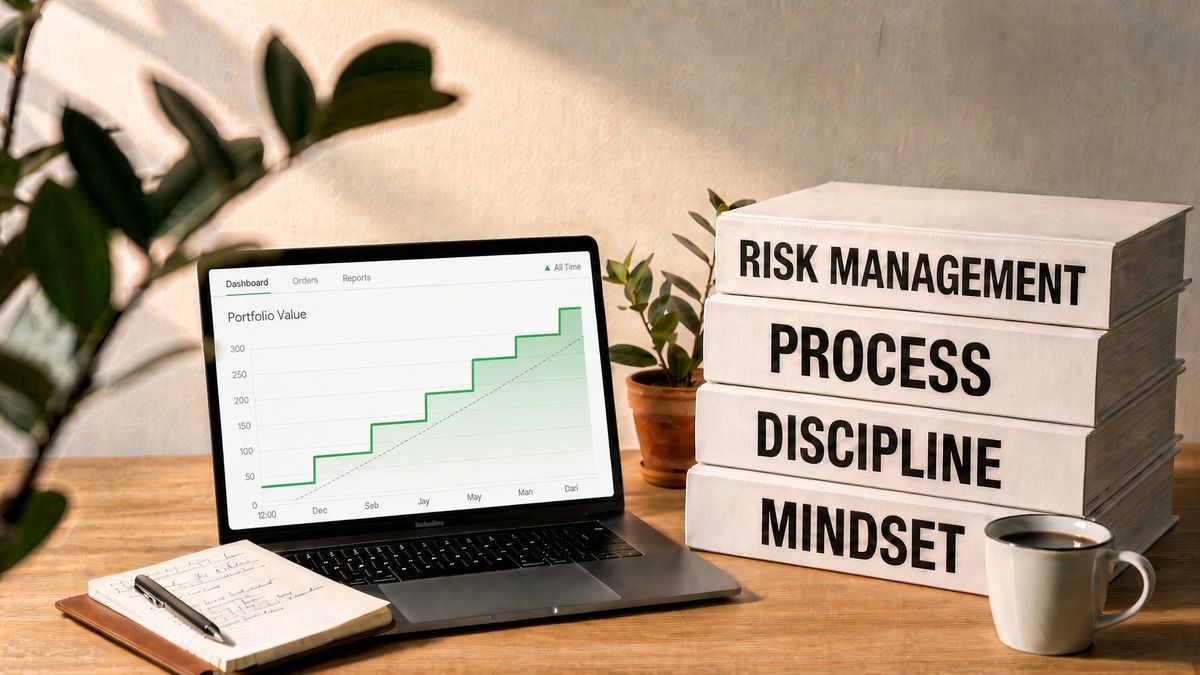
For years I thought I was one indicator away from figuring this out. I wasn't. I was missing four things: risk management, process, discipline and mindset. Here's how each one shows up in my trading now.

For years I thought I was one indicator away from figuring this out.
I learned technical analysis. I followed traders on X and paid for services that sent me trade ideas. I passed a couple of prop firm evaluations and still ended up with a net loss. Looking back, I wasn't really trading so much as gambling with nicer charts.
The turning point came in early 2026, and it wasn't a new setup. It was a hard look in the mirror. The knowledge was mostly there, but what I didn't have was a strategy, a process and an honest understanding of myself. My biggest stumbling block was me.
Since then, my results have started to look like something I can build on. The full record, losing months included, is on the Results page.
I've come to think of consistency as resting on four pillars: risk management, process, discipline and mindset. Take one away and the whole thing leans. This is how each one shows up in my own trading. It's not a blueprint for yours. I share what I'm doing, not what you should do.
1. Risk management: count the cost first
In 2020 I traded crypto on margin and came close to being liquidated. I was forced to sell near the bottom, then watched the market rebound without me. My read on the market wasn't the real problem. My position was simply too big to survive a sharp drop. That's what trading without risk management feels like.
Risk management is the pillar that keeps me in the game long enough for the other three to matter. Here's what it looks like for me now:
- Every trade has an exit before it has an entry. I know where I'm wrong before I think about where I might be right.
- Size comes from the stop, not from excitement. How much I buy is worked out from the distance to my stop, not from how good the chart looks.
- A losing streak should hurt, not end me. Risk per trade is small enough that five losses in a row is uncomfortable, not catastrophic.
- I watch total open risk, not just each trade. All my open positions together sit under a ceiling.
In 2025, oversizing kept turning good stretches into giveback. I'd string together a strong few weeks, get confident, size up and hand it all back. The setups weren't the problem. The size was.
So now, before I build a position, I count the cost first. Not what I could make, but what it costs me if I'm wrong.
2. Process: decide on Saturday, execute on Monday
With a full-time job and a family, I can't sit in front of screens all day, so I do my thinking ahead of time. When the market is open, I'm not deciding what to trade. I'm only checking whether the trades I already planned show up.
My Saturday starts with a devotional. After that, I review the past week and plan the next one in four steps:
- Review last week. What went well, what didn't, and why.
- Read the market. Is the overall market healthy, shaky or falling? I use my own gauge for this, which I call The Throttle.
- Find the strongest stocks. I look for the stocks and sectors holding up better than the rest of the market.
- Write the plan. A short list of trades I'd take, with the entry, the exit if I'm wrong and the size all decided in advance.
My strategy, Genesis Velocity, is momentum swing trading. In plain terms, I buy strong stocks as they break out of a quiet period and hold them for as long as the uptrend holds, taking some profit along the way when the price runs well ahead of itself.
The Throttle isn't a hard rule. It's a gauge, and it's most useful when the market is turning and less useful when the market is moving sideways.
Every trade then goes into my journal. Doing the same steps every week means I can measure what works, and I can only improve what I measure.
3. Discipline: keeping the promises I make to myself
Discipline is easy to misunderstand, so let me be upfront. I'm not a rules-only trader. I use a lot of judgment. If a group of stocks is clearly beating the market, I'll follow that strength even when the overall market looks shaky. There have been days when The Throttle was flashing yellow and I was more than 100% invested.
So for me, discipline isn't about doing whatever the gauge says. It's about keeping my risk rules fixed, even when I go against my own market read. Every position is still sized from where my stop sits, my total risk still has a limit, and my stops only ever move up.
The rest of discipline is quieter, and a lot less exciting:
- Sticking to the process, like doing the Saturday review when I'd rather sleep in.
- Waiting for the A+ setups instead of taking so-so trades out of boredom.
- Not revenge trading to win back a loss.
- Logging my bad trades as honestly as my good ones, and studying what I did wrong as closely as what I did right.
Most of what I gave back in 2025 came from overtrading. I knew what a good setup looked like, but I took plenty that weren't. That wasn't a knowledge problem. It was a discipline problem, and becoming more disciplined is a big part of what finally got me out of that boom and bust cycle.
4. Mindset: the pillar under the other three
This is where my turnaround actually started. Early in 2026 I worked through a stack of trading psychology books, which says a lot for someone who was never much of a reader, and I kept seeing myself in the pages: the fear of missing out, the need to be right, and the way my mood rose and fell with my P&L.
Two habits help me most now. Every Saturday I run a Mistake Audit alongside a list of Cellys, the trades worth celebrating, and the two always run together. A review that only looks at mistakes breeds fear, while one that only looks at wins breeds arrogance, so together they keep me both honest and motivated.
Mindset is also where my faith shows up most clearly. My worth isn't measured by my equity curve, so a red week doesn't change who I am, and neither does a green one. That frees me to take a loss without needing to win it back today, and to enjoy a good month without thinking I've figured it all out.
You don't have to share my faith for the principle to hold. When your identity is tied to your account balance, every trade ends up carrying more weight than it should.
Built on rock
Four pillars can hold up a building, but only if they're standing on something solid. In trading, the storm always comes, whether it's a drawdown, a choppy market or a run of losses that makes you question everything. Good structure won't stop the storm, but it does mean you're still standing when it passes.
Looking back, I was never one indicator away from figuring this out. I was four pillars away, and the one I ignored the longest turned out to be the one holding up the rest.
I'm still working on all four, and some weeks one is stronger than the others. That's the journey, and I'll keep sharing it, mistakes included, in The Saturday Review. If you want to follow along, subscribe here and it lands in your inbox every Saturday.
This is my personal trading journal, not financial advice. I share what I'm doing, not what you should do. Trading involves risk, including the loss of capital. Do your own research and consider speaking with a qualified professional before making financial decisions.